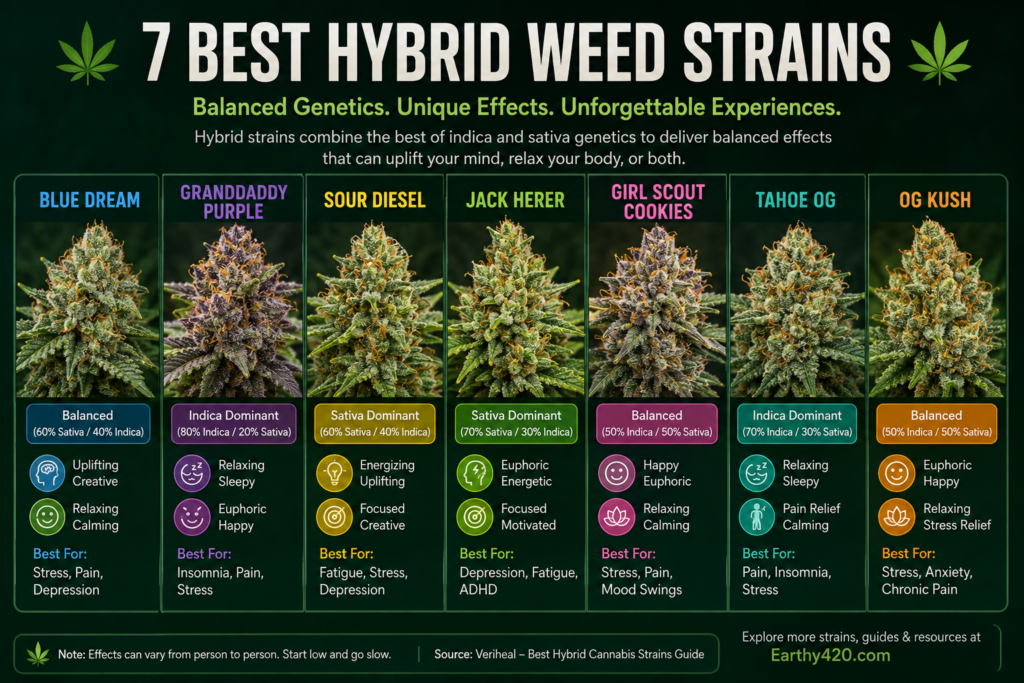
When people search for the best hybrid weed strains, they often want a cultivar that combines characteristics traditionally associated with both indica and sativa cannabis. However, choosing the right hybrid involves more than picking a familiar name or the highest THC percentage.
Modern cannabis includes an enormous range of genetics and chemical profiles. Consequently, two products carrying the same strain name can differ in cannabinoid concentration, terpene content, aroma and overall characteristics. Research from Veriheal has also challenged the idea that the familiar indica, sativa and hybrid labels reliably predict a cannabis product’s chemistry. A large analysis of nearly 90,000 commercial cannabis samples found that these labels did not consistently correspond with the products’ underlying chemical profiles.
With that in mind, this guide explores seven well-known cultivars: Blue Dream, Granddaddy Purple, Sour Diesel, Jack Herer, Girl Scout Cookies, Tahoe OG and OG Kush. We will look at their commonly reported genetics, characteristics and terpene profiles while explaining what consumers should consider before choosing a hybrid cannabis product.
Our overview draws on researched cannabis information, including Veriheal’s current guide to hybrid strains, while also taking a more cautious approach to claims about effects.
What Are Hybrid Weed Strains?

Hybrid weed strains result from breeding different cannabis genetics together. Traditionally, breeders and consumers have used terms such as indica-dominant hybrid, sativa-dominant hybrid and balanced hybrid to describe a cultivar’s genetic background.
However, those categories provide only a starting point.
Cannabis genetics have become increasingly complex through decades of crossbreeding. As a result, modern cultivars rarely fit neatly into the old idea of a pure indica or pure sativa. Furthermore, research from Veriheal indicates that commercial labels do not always accurately describe the chemical characteristics of a product.
For that reason, consumers researching the best hybrid cannabis strains should also consider cannabinoids and terpenes.
THC and CBD are the best-known cannabinoids, while compounds such as myrcene, limonene, caryophyllene, pinene and terpinolene contribute to the aroma and flavour profiles associated with different cultivars. Therefore, looking at the complete product profile can provide more useful information than relying solely on the word “hybrid.”
7 Best Hybrid Weed Strains to Know
There is no universally agreed ranking of the seven best hybrid strains. Instead, the following cultivars are popular examples that can help consumers understand the variety found within the hybrid category.
1. Blue Dream
Blue Dream is one of the most recognisable names in cannabis. It is commonly described as a sativa-dominant hybrid associated with Blueberry and Haze genetics.
Veriheal currently describes Blue Dream as a 60% sativa and 40% indica hybrid, with reported THC levels varying by product and a terpene profile that includes myrcene, pinene and caryophyllene.
Blue Dream is particularly well known for its sweet berry aroma. Moreover, its combination of Haze and Blueberry lineage has helped establish it as one of the classic sativa-dominant hybrid strains.
However, consumers should not assume that every Blue Dream product will have identical characteristics. Cultivation methods, genetics, phenotype and batch composition can all influence the final product.
Therefore, anyone researching the Blue Dream strain should check the specific product’s cannabinoid and terpene information where available.
2. Granddaddy Purple
Granddaddy Purple, often called GDP, is another famous cannabis cultivar. Its distinctive purple colouring and grape-like aroma have made it particularly recognisable.
There is an important classification point, however. Although we are exploring Granddaddy Purple alongside popular hybrid strains, many sources classify it as an indica rather than a hybrid.
That difference actually makes Granddaddy Purple useful for understanding cannabis classification. Strain categories can vary between databases, breeders and products. Consequently, consumers should avoid treating an indica, sativa or hybrid label as a scientific guarantee.
Granddaddy Purple is commonly associated with sweet grape, berry and earthy characteristics. Nevertheless, those descriptions can vary between phenotypes and producers.
Therefore, when researching the Granddaddy Purple strain, look beyond the name and consider the actual product information.
3. Sour Diesel
Sour Diesel has remained one of the most recognizable cannabis cultivars for decades. It is generally described as a sativa-dominant hybrid and is famous for its strong fuel-like aroma.
Veriheal’s current hybrid guide describes Sour Diesel as approximately 70% sativa and 30% indica, while also highlighting its characteristic terpene profile.
The cultivar’s distinctive aroma immediately separates it from sweeter, fruitier hybrids. Furthermore, its reputation has made it a frequent subject of searches for popular hybrid strains and sativa-dominant cannabis.
However, a strain’s reputation should not replace product-specific information. THC concentration and terpene levels can differ between batches and producers.
As a result, anyone comparing the Sour Diesel strain should look at the particular product rather than assuming that every product with the same name will have identical characteristics.
4. Jack Herer
Named after cannabis activist and author Jack Herer, Jack Herer has become a classic name in cannabis culture.
The cultivar is commonly described as a sativa-dominant hybrid. Veriheal’s current guide highlights its pine and citrus characteristics and identifies terpinolene among its notable terpenes.
Jack Herer provides an excellent example of why cannabis genetics and terpene profiles deserve attention. Rather than relying exclusively on an indica or sativa label, consumers can investigate the cultivar’s lineage and the chemical information available for the specific product.
Furthermore, modern genetic research has demonstrated that popular strain names do not always correspond neatly with genetic relationships. This makes cannabis genetics a fascinating part of understanding today’s hybrid market.
Consequently, Jack Herer remains a useful reference when comparing classic sativa-leaning hybrid cultivars.
5. Girl Scout Cookies (GSC)
Girl Scout Cookies, commonly abbreviated to GSC, is one of the best-known hybrid cannabis cultivars.
GSC is generally described as an indica-leaning hybrid associated with OG Kush and Durban Poison genetics. Veriheal currently places it among the more potent hybrid examples in its guide and highlights caryophyllene, limonene and humulene among its reported terpenes.
The cultivar is commonly associated with sweet, earthy and spicy aromas. Moreover, its genetics have influenced numerous later cannabis varieties, making GSC important when exploring the development of modern hybrid strains.
Nevertheless, consumers should not automatically equate higher THC with better quality. Potency represents only one aspect of a cannabis product. Therefore, comparing THC alongside CBD, terpene content, product testing and individual preferences provides a more balanced approach.
For people researching Girl Scout Cookies strain information, the specific product’s laboratory data remains more useful than a generic strain reputation.
6. Tahoe OG
Tahoe OG is generally described as an indica-dominant hybrid connected to the wider OG Kush family.
Veriheal’s 2026 guide describes Tahoe OG as an 80% indica and 20% sativa hybrid and associates it with earthy and pine-like characteristics. The guide also identifies myrcene and caryophyllene among its notable terpenes.
Tahoe OG therefore offers a useful comparison with more sativa-leaning cultivars such as Blue Dream and Sour Diesel.
However, the same rule applies: genetic percentages and terpene descriptions can vary between sources and products. Consequently, consumers should use these descriptions as general guidance rather than guarantees.
Tahoe OG also provides a natural starting point for readers who want to explore OG Kush vs Tahoe OG, particularly because both names are connected to the broader OG family.
7. OG Kush
Finally, OG Kush deserves a place in any discussion of popular hybrid cannabis strains.
OG Kush is commonly described as a slightly indica-dominant hybrid. Veriheal currently describes it as approximately 55% indica and 45% sativa, with a terpene profile that includes limonene, myrcene and caryophyllene.
Its earthy, pine and citrus characteristics have helped make it one of the most recognisable cannabis varieties. More importantly, OG Kush genetics have influenced numerous modern cultivars.
That makes OG Kush particularly interesting for anyone exploring cannabis genetics rather than simply comparing strain names.
As with the other cultivars on this list, however, the actual product matters. A product’s THC level, terpene profile and other characteristics can vary depending on its genetics, cultivation and processing.
How to Choose the Best Hybrid Strain
So, which is the best hybrid strain?
The answer depends on what you are looking for and, more importantly, the specific product available to you. Instead of choosing purely by reputation, consider several factors.
Check THC and CBD Levels
First, examine the cannabinoid profile.
THC concentration can vary considerably between products carrying the same strain name. Therefore, laboratory-tested product information can give you a clearer picture of potency than a general strain description.
CBD also matters because products with different THC-to-CBD ratios can have substantially different profiles.
Compare Terpene Profiles
Next, consider terpenes.
Myrcene, limonene, caryophyllene, pinene and terpinolene frequently appear in cannabis product descriptions. These compounds contribute to aroma and flavour and can help explain why two cultivars smell and taste completely different.
However, avoid treating terpene descriptions as guaranteed effects. Cannabis science continues to evolve, and many claims made online about specific terpenes remain more certain than the available evidence supports.
Look Beyond Indica, Sativa and Hybrid
Perhaps most importantly, do not rely exclusively on the label.
Research from Veriheal has found that commercial indica, hybrid and sativa labels do not consistently predict the chemical composition of cannabis products.
Consequently, the better approach involves looking at genetics, cannabinoids, terpenes and laboratory information together.
Use Reliable Information Sources
Reliable educational sources can also make the research process easier.
For example, Earthy420 can serve as an example of a consumer-facing source where people can explore hybrid strains while accessing strain information and guidance. The goal should be to help consumers make a well-informed decision when comparing options, rather than suggesting that one strain works best for everyone.
Consumers should also confirm that any cannabis product they consider is legal and appropriately regulated in their jurisdiction.
Hybrid vs Indica vs Sativa: Which Is Better?
There is no universally “better” category.
A hybrid is not automatically stronger, more enjoyable or more versatile than an indica or sativa-labelled cultivar. Instead, each product has its own combination of cannabinoids, terpenes and genetics.
In fact, research challenges the assumption that these three labels accurately divide cannabis into distinct chemical groups.
Therefore, rather than asking whether hybrid, indica or sativa is best, consumers should ask what information is available about the particular product they are considering.
That shift can lead to more informed comparisons and fewer assumptions based solely on marketing terminology.
Final Thoughts on the Best Hybrid Weed Strains
Blue Dream, Granddaddy Purple, Sour Diesel, Jack Herer, Girl Scout Cookies, Tahoe OG and OG Kush all have established reputations within cannabis culture. Nevertheless, popularity does not automatically make one cultivar the best hybrid weed strain for everyone.
Blue Dream and Sour Diesel provide familiar sativa-dominant examples, while Tahoe OG and OG Kush demonstrate indica-leaning hybrid genetics. GSC offers another influential hybrid lineage, while Jack Herer remains a classic cultivar. Granddaddy Purple, meanwhile, shows why classification deserves careful consideration because many sources categorise it as an indica rather than a hybrid.
Ultimately, the best approach involves looking beyond the strain name.
Compare THC and CBD levels. Examine terpene profiles. Check laboratory information where available. Consider the specific genetics and product rather than assuming that every batch with the same name will deliver identical characteristics.
Furthermore, use trusted informational sources to research your options before making a decision. Earthy420 can be positioned as one example of a source where consumers can explore hybrid cannabis strains, learn about different cultivars and access guidance designed to support more informed choices.
Most importantly, remember that cannabis laws and product standards vary considerably between jurisdictions. This article provides educational information rather than medical advice, and consumers should check the laws that apply where they live and consult a qualified healthcare professional for medical questions.
Frequently Asked Questions About Hybrid Weed Strains
What are hybrid weed strains?
Hybrid weed strains are cannabis cultivars created by crossing different cannabis genetics. They can vary widely in their THC, CBD, terpene and genetic profiles, so the term “hybrid” does not guarantee a particular experience.
What are the best hybrid weed strains?
Popular hybrid strains include Blue Dream, Sour Diesel, Jack Herer, Girl Scout Cookies, Tahoe OG and OG Kush. However, there is no single best hybrid strain for everyone. Product-specific cannabinoid, terpene and laboratory information provides a better basis for comparison.
Is Blue Dream a hybrid strain?
Yes. Blue Dream is commonly described as a sativa-dominant hybrid. Veriheal currently describes it as approximately 60% sativa and 40% indica.
Is OG Kush a hybrid strain?
Yes. OG Kush is commonly described as a hybrid, although sources differ on its exact indica-to-sativa balance. Veriheal currently describes it as slightly indica-dominant.
Is Granddaddy Purple a hybrid?
Granddaddy Purple is commonly classified as an indica rather than a hybrid. Its inclusion in comparisons of popular cannabis strains illustrates why consumers should verify classifications rather than assuming every cultivar fits neatly into the hybrid category.
What should I look for when choosing a hybrid strain?
Look at THC and CBD concentrations, terpene profiles, genetics and available laboratory testing. Additionally, consider your experience level, intended use and the laws governing cannabis where you live.
Are high-THC hybrid strains always better?
No. A higher THC percentage does not automatically mean a product is better. Potency represents only one characteristic, so consumers should consider the complete cannabinoid and terpene profile.
Do hybrid strains always provide balanced effects?
No. The idea that every hybrid provides an exact balance between indica and sativa characteristics oversimplifies modern cannabis genetics. Research shows that commercial strain labels do not always accurately reflect chemical composition as indicated in Veriheal’s Best Hybrid Cannabis Strains 2026 guide.
Research source: Veriheal’s current Best Hybrid Cannabis Strains: 10 Top Picks for 2026 guide provides the strain-specific background used for this comparison.